How to work with a building business accountant to understand your numbers and build a more profitable business
Know what your numbers are telling you.
If you want a more profitable building business, you need to understand what is actually happening with your money. A good building business accountant can help you make sense of your financial position, project costs, cash flow and profitability, but only if you work with them as part of your wider business team.
Too many builders only sit down with their accountant at tax time. By then, the numbers are history. The opportunity to spot a problem, protect a project margin or make a better decision has already passed.
Your accountant should help you understand what the numbers are telling you while there is still time to act.
Be sure to also subscribe to the Live Life Build YouTube channel.
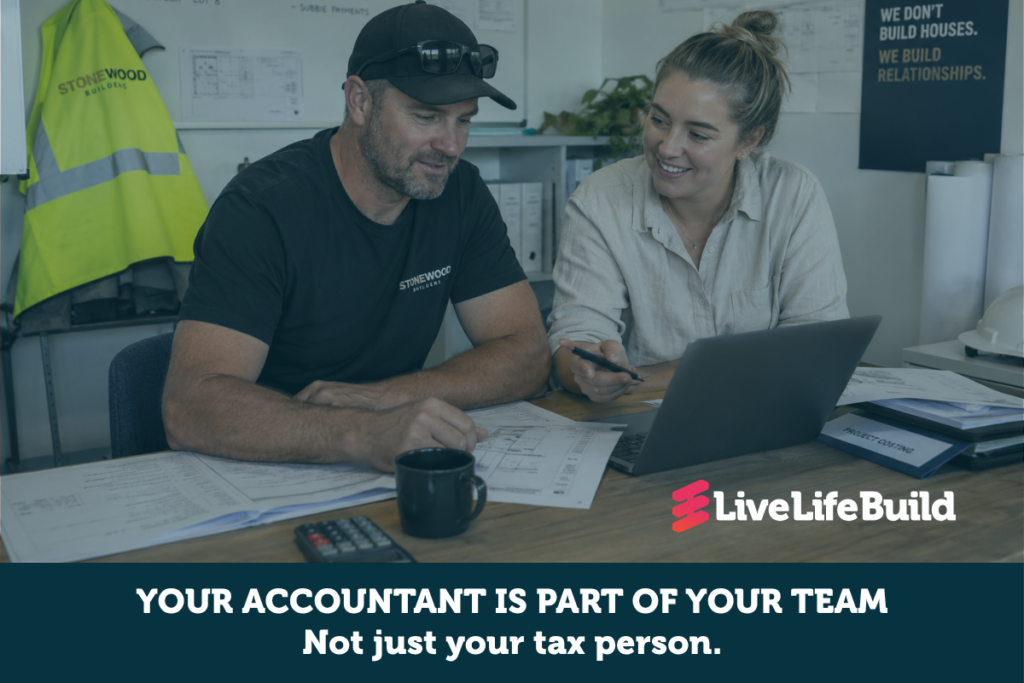
Stop treating your accountant as someone you only see at tax time
Your accountant should be more than the person who prepares your accounts and tells you how much tax you owe.
Think of them as another member of your business team.
Regular conversations give you the chance to understand what is happening now, rather than waiting until the end of the financial year to discover what happened months ago.
For some businesses, monthly reviews may be appropriate. For others, a fortnightly review may make sense, particularly when there is a lot of project activity and cash moving through the business.
The important thing is consistency.
- When you regularly review your numbers, you can start asking better questions:
- Is the business actually making money?
- Is cash flow keeping pace with the commitments coming up?
- Are projects tracking against their budgets?
- What is currently owing to suppliers and subcontractors?
- What money is still coming into the business?
- What tax and other obligations are coming up?
- How much money is being taken from the business?
- Are your overheads under control?
You do not need to become an accountant. You do need to understand the information that helps you run your business.
Find an accountant who understands construction
A building business is not the same as a typical service business.
Large amounts of money can move through your accounts without becoming profit. Client payments need to cover project costs, suppliers, subcontractors, employees, overheads and other business obligations before you can understand what the business has actually earned.
That is why construction experience matters.
You want an accountant who understands the way building businesses operate and can explain the numbers in language you can use.
It is also worth asking questions before you commit to a relationship:
- Do they work with other builders?
- Do they understand the financial requirements relevant to your state or territory?
- Will they meet with you regularly?
- Will they help you understand the reports rather than simply send them to you?
- Can they help you plan ahead, not just deal with the past?
- Do they understand the difference between turnover, gross profit, net profit and available cash?
The right relationship can give you much more than tax advice. It can give you better financial visibility.
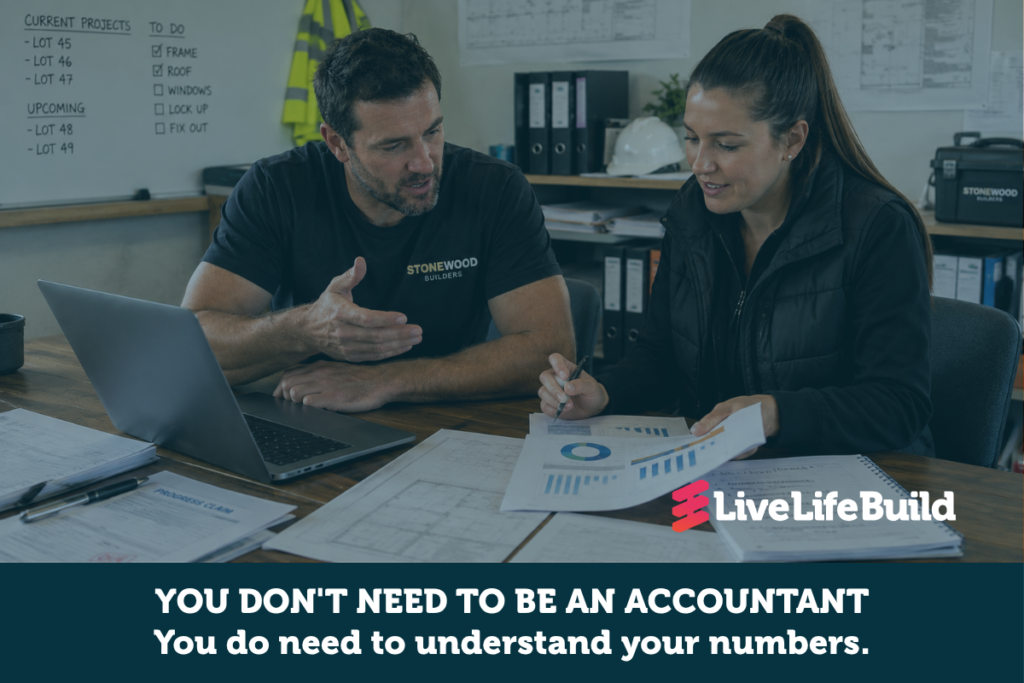
Learn the language without being embarrassed by it
Profit and loss statements. Gross profit. Net profit. Accounts payable. Accounts receivable. Cost of goods sold. Overheads. Owner’s equity.
If these terms make your eyes glaze over, you are not alone.
Builders spend years learning how to manage trades, projects, materials, clients and construction details. You would never expect a homeowner to understand every construction term you use, so there is no reason to feel embarrassed about asking your accountant to explain theirs.
In fact, asking questions is one of the best things you can do.
A good accountant should be willing to explain what the numbers mean and how they relate to your business.
Once you understand the language, financial reports become much more useful. Instead of looking at a page of numbers and hoping everything is okay, you can start seeing where the business is performing well and where something needs attention.
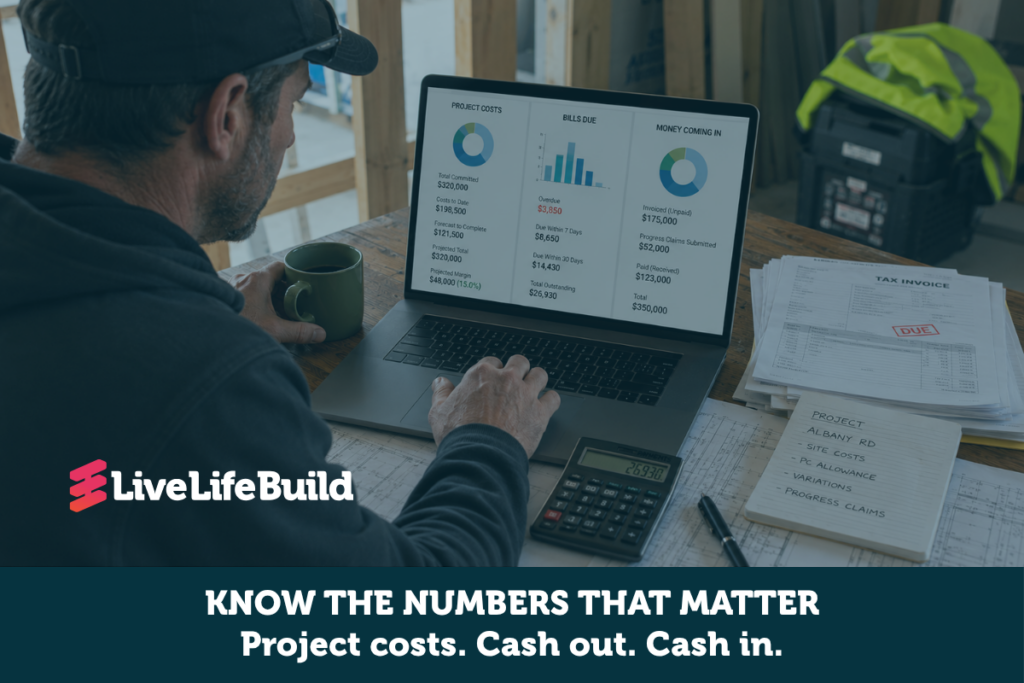
Focus on the reports that help you make decisions
There are countless reports available in modern accounting systems. You do not necessarily need to study every one.
The goal is to identify the information that gives you a clear picture of what is happening in your business.
Three areas can be particularly useful for a builder.
Project costs
You need to know how your actual project costs are tracking against what you allowed for when you priced the work.
If costs are moving in the wrong direction, knowing early gives you a chance to investigate and respond before a small problem becomes a major hit to your margin.
Accounts payable
These are the bills the business needs to pay.
Reviewing what is due, when it is due and what other obligations are approaching helps you understand the pressure on your cash flow.
Accounts receivable
This is the money that is coming into the business.
Understanding what is owed, when payments are expected and how that aligns with your upcoming commitments helps you make better decisions about cash.
The specific reports you use will depend on your business and accounting system. The important thing is that you have a regular process for reviewing the information that matters.
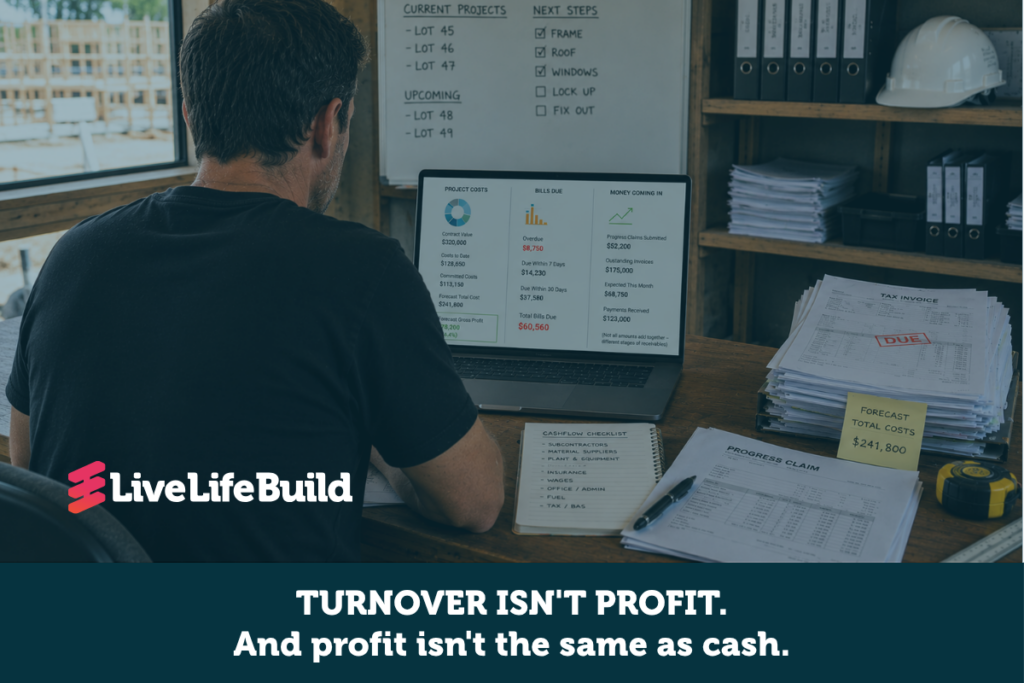
Understand the difference between profit and cash
One of the biggest financial traps for builders is assuming that a profitable business should always have plenty of money sitting in the bank.
Profit and cash are connected, but they are not the same thing.
You can have money coming into the business while also having substantial commitments going out. Client payments may need to cover subcontractors, materials, wages, overheads, GST, tax and other obligations.
That means a healthy bank balance today does not automatically mean you have money available to spend.
Likewise, an accountant telling you that the business has made a profit does not necessarily mean you should immediately spend the money sitting in the bank.
This is where regular financial conversations become so valuable.
Your accountant can help you understand what the business has earned, what it owes, what is coming in and what needs to be set aside.
That clarity can help you avoid making decisions based on the balance of your bank account alone.
Make your numbers part of your project management
Your financial numbers should not live separately from your projects.
The more accurately you track project costs, the more useful your financial information becomes.
When actual costs are allocated to the right projects and categories, you can see how individual jobs are performing. Over time, that information also becomes valuable data for future pricing.
- You can start identifying patterns:
- Which trades consistently track close to budget?
- Where are costs regularly underestimated?
- How much labour does a particular stage really take?
- Are variations being captured properly?
- Are overheads being covered?
- Are your project margins holding up?
This is where financial management becomes practical rather than theoretical.
You are not looking at numbers simply because your accountant told you to.
You are using them to make decisions about the work you are doing every day.
Pay yourself properly and understand what your business can afford
Your business needs to account for the work you do.
If you are spending evenings in the office, supervising sites, pricing work, managing clients or doing administration without accounting for that time, your business may look healthier than it really is.
The same applies if your partner is working in the business without their contribution being properly recognised.
A sustainable business needs to understand the true cost of the work required to operate it.
This also matters when you start thinking about growth.
If the business depends on unpaid labour from you or your partner to keep operating, adding an administrator, supervisor or other team member can appear unaffordable.
But the bigger question is whether your current business model is genuinely profitable once all of the work required to operate it has been accounted for.
That is the kind of question worth discussing with your accountant.
Use your accountant to become more financially confident
You do not need to love numbers.
You do not need to spend your evenings studying accounting.
But you do need enough financial understanding to make informed decisions about your business.
The strongest relationship with your accountant is not one where you hand everything over and hope for the best.
It is one where you can sit down together, ask questions, understand what the reports are telling you and use that information to make better decisions.
Your accountant brings financial expertise.
You bring knowledge of your projects, clients, team and business.
Together, that information can give you a much clearer picture of what is really happening.
Building Business Accountant and Elevate: Know Your Numbers, Build With More Confidence
Understanding your numbers is one part of building a business that supports both profitability and the life you want outside work.
When you have better visibility over your finances, you can make decisions earlier, protect your project margins and build a business that is less dependent on guesswork.
That is the kind of practical business thinking we work on inside Elevate, alongside the systems, standards, support and community that help builders create sustainable success.