Subcontractors vs employees: choosing the right team structure for your building business and the projects you want to deliver
Grow with a plan, not a panic.
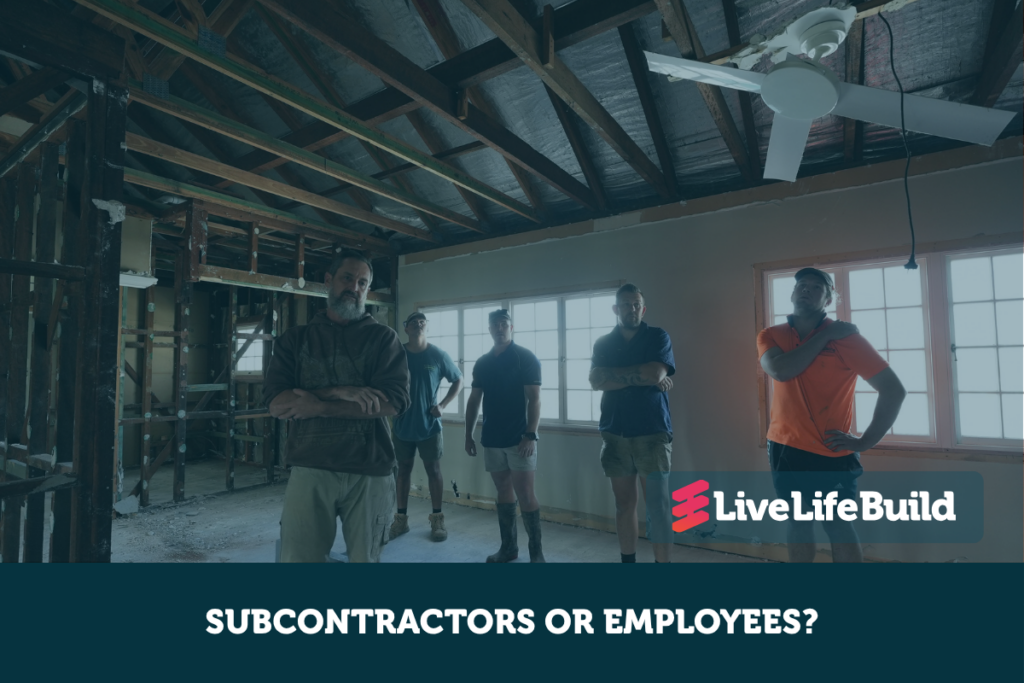
As your building business grows, the question of subcontractors vs employees can become a difficult one.
Do you bring more people onto the books and build a team around your business, or rely on subcontractors so you have more flexibility when work changes?
Be sure to also subscribe to the Live Life Build YouTube channel.
There is no single answer that works for every builder.
The right structure depends on the type of business you want to build, the projects you take on, the standards you expect, your cash flow, your capacity and the kind of life you want your business to support.
The important thing is not simply choosing between employees and subcontractors. It is making a deliberate decision instead of reacting every time the workload changes.
Start with the building business you actually want
Before you decide who to hire, step back and ask a bigger question:
What type of building business are you trying to create?
If your business is designed to grow sustainably, you need enough work coming through the pipeline to support the people you bring into the business.
If work rises and falls dramatically, a permanent team can create pressure when there is not enough work to keep everyone productive. On the other hand, relying heavily on subcontractors can create its own pressure when you are busy and suddenly need extra capacity.
This is where planning matters.
Your team structure should support your business model, not dictate it.
A clearer project pipeline can also give you more confidence about when you will need people, what skills you will need and whether you are building towards a sustainable team or simply trying to survive the next busy period.
Think about the projects you want your team to deliver
The type of projects you build should influence the type of team you create.
Consider:
- What level of quality do your clients expect?
- What work needs to be completed consistently?
- Where do you need greater control?
- Which skills need to be available when you need them?
- Where would flexibility be more valuable?
- What happens to quality when you are under pressure?
- How much responsibility can you realistically delegate?
If your business promises a particular standard, your team structure needs to make that standard achievable.
The Successful Builder Solution places Team within the Quality Code, alongside Systems and Beyond the Code Building Methods. That is important because your people are not separate from the quality of your business. They are part of how that quality is delivered.
A team that understands your expectations, knows their responsibilities and can work within your systems gives you a much stronger foundation for consistent delivery.
Understand what employees can give your business
Employees can provide stability, availability and a deeper connection to the way your business operates.
When you invest in people over time, you can develop their skills, teach them your expectations and build a stronger understanding of how you want projects delivered.
That investment can also support culture and engagement.
But permanent employees come with responsibility. You need to think about wages, overheads, training, productivity, workload and the periods when your pipeline may be quieter.
The question is not simply, “Can I afford another employee?”
Ask instead:
Can my business consistently support this role, and will this person help me build the business I want?
That is a much more strategic question.
Understand where subcontractors can give you flexibility
Subcontractors can give builders the ability to scale capacity around project demand.
That flexibility can be valuable when your workload changes or when you need specialist skills for particular projects.
You may also be able to bring different subcontractors into projects as your pipeline changes.
But flexibility does not automatically mean simplicity.
If subcontractor performance, communication or availability becomes inconsistent, you can end up spending more time checking work, solving problems and filling gaps.
That can become a Business Black Hole.
Instead of the flexibility creating freedom, the builder can become the person constantly coordinating, correcting and chasing.
Understand the legal and compliance side before you decide
There is an important distinction between choosing a team structure and deciding whether a particular worker can legally be engaged as a contractor.
In Australia, whether someone is an employee or an independent contractor depends on the circumstances of the relationship. The relevant factors can include the level of control over the work, financial responsibility and risk, who supplies tools and equipment, the ability to delegate or subcontract, hours of work and whether the work is expected to continue. The rules and tests can also differ depending on the type of business and the circumstances of the relationship.
That means an ABN, an invoice or calling someone a subcontractor does not, by itself, determine their legal status.
For a building business, getting this wrong can have employment, tax, superannuation and other compliance implications. If you are unsure about a particular arrangement, get appropriate professional advice before making the decision.
This article is general business guidance, not legal or tax advice.
Compare the real cost, not just the hourly rate
One of the easiest mistakes is comparing an employee and a subcontractor based only on the immediate cost.
Look at the bigger picture.
| Consideration | Employees | Subcontractors |
| Capacity | Can provide more predictable ongoing capacity | Can provide flexibility around project demand |
| Skills | Can be developed over time within your business | Can provide access to specialist skills as needed |
| Training | You can invest in developing capability | Usually relies more on the contractor’s existing capability |
| Availability | You generally plan around an ongoing employment arrangement | Availability can depend on the contractor’s other commitments |
| Control | Your business manages the employment relationship and work expectations | The nature of the contracting relationship generally provides greater independence |
| Overheads | Includes employment-related costs and responsibilities | Costs are generally agreed through the contracting arrangement |
| Management time | Can reduce reliance on repeatedly finding external labour, but requires people management | Can increase coordination if multiple subcontractors are involved |
| Scalability | Can be less flexible when workload changes quickly | Can provide more flexibility when genuine contracting arrangements are appropriate |
The table is a planning tool, not a test for whether a worker is legally an employee or contractor. Classification depends on the specific circumstances of the relationship.
The bigger question is what each option actually costs your business when you consider:
- Productivity
- Quality of workmanship
- Availability
- Training and development
- Supervision
- Control
- Flexibility
- Team engagement
- Culture
- Project outcomes
- Business overheads
- Your own time and energy
A lower apparent cost can become expensive if it creates rework, delays, poor communication or more management for you.
Likewise, an employee who costs more on paper may create greater value if they improve consistency, take responsibility and reduce the amount of work that comes back to you.
The goal is not to find the cheapest option.
The goal is to understand the total business impact and choose a structure that supports the outcome you are trying to create.
Look at what your team structure is doing to your time and energy
This decision is not only about money.
It is also about your life.
If you are constantly scrambling for labour, solving subcontractor problems, covering gaps or keeping people busy, your team structure may be contributing to the pressure you are trying to escape.
That matters because Wellbeing is one of the three Codes in the Successful Builder Solution.
Your business should not require you to sacrifice your health, identity or relationships just to keep projects moving.
A team structure that looks financially efficient but leaves you exhausted may not be supporting the success you actually want.
You do not have to choose one model forever
Growing your team does not have to be an all-or-nothing decision.
You may choose to build a core team of employees and use subcontractors for additional capacity, where those contracting arrangements are appropriate.
You may start with subcontractors while your pipeline becomes more predictable, then bring key roles in-house as the business grows.
You may also collaborate with other builders and share resources when demand changes.
The important part is that the structure is intentional and compliant.
Your team can evolve as your business evolves.
Avoid turning growth into another Business Black Hole
A common trap is adding people because you are busy, without fixing the systems around them.
More people do not automatically create more capacity.
If responsibilities are unclear, processes are inconsistent and nobody knows who owns a decision, adding another person can simply add another layer of communication.
That is where team growth can become another Business Black Hole.
Before you add headcount, ask:
What problem am I actually trying to solve?
- Is it a lack of labour?
- A lack of systems?
- A lack of delegation?
- A lack of planning?
- A lack of accountability?
Or are you simply trying to cope with too much work landing on you?
The answer will determine what you actually need.
Build the team around your definition of success
The Successful Builder Solution is built around a simple idea: success is not one-size-fits-all.
A bigger team is not automatically a better business.
More employees do not automatically mean more success.
More subcontractors do not automatically mean more freedom.
The right team is the one that supports the business, projects and life you are intentionally building.
That means considering profitability, quality and wellbeing together.
When those three areas work together, growth becomes much more sustainable.
Subcontractors vs employees: take the next step with Elevate
If you are at the point where your team is growing, your projects are increasing and you are wondering what needs to change next, you do not have to work it out alone.
Elevate helps custom residential builders step back from the day-to-day pressure, identify what is really holding the business back and put practical systems and strategies into place.
Because growing a team should not simply give you more people to manage.
It should help you build a better business, better projects and a better life.
Learn more about Elevate and see how it could support the next stage of your building business.