How managing client enquiries with a clear process helps custom residential builders save time, qualify leads and create better client relationships
Stop letting every enquiry become your problem.
Client enquiries are often the first real interaction a potential client has with your building business. If that interaction starts with a builder answering their mobile while standing on site, driving between projects or trying to remember who called after hours, the experience can become reactive very quickly.
A clear process for managing client enquiries helps you protect your time, gather the right information, identify suitable projects and create a professional first impression from the outset.
It also helps you stop treating every enquiry as an opportunity that automatically deserves hours of your time.
Be sure to also subscribe to the Live Life Build YouTube channel.
Here are five practical steps to create a better enquiry process.
1. Create one clear pathway for client enquiries
The first step is to decide exactly how potential clients should enter your business.
That might be an online enquiry form, an enquiry page on your website, an admin-managed phone line or another system that suits your business.
The important thing is that the pathway is clear and consistent.
If your mobile number is the main entry point, you can end up taking calls while driving, working on site, talking to another client or spending time with your family.
You might not have the opportunity to record the details you need. You might forget to follow up. Or the potential client may receive a rushed conversation simply because they happened to call at the wrong moment.
Social media DMs can create a similar problem. An enquiry can sit among other messages, be missed, or become a conversation that is difficult to track.
A better approach is to give every potential client the same next step, regardless of whether they first contact you by phone, email or social media.
That could be as simple as sending them a link to your enquiry form with a standard response.
The goal is not to make it difficult for people to contact you.
The goal is to make the next step easy for both of you.
2. Gather the information you need at the outset
Not every enquiry is a viable project.
Some people are years away from building. Some have expectations that do not match their budget or timeframe. Some projects simply do not suit your business model.
That does not make those people bad clients. It means you need enough information to understand whether there is a sensible next step.
Your enquiry form might ask about:
- The project address
- The type of project
- The stage they are currently at
- Their expected timeframe
- Their budget range
- What they are hoping to achieve
- How they found your business
The exact questions should reflect your business.
The point is to learn enough before investing significant time in a conversation, site visit or pricing exercise.
This is closely connected to the Profitability Code within the Successful Builder Solution, particularly the standard of the right clients with the right process.
When you understand who is contacting you and what they are looking for, you can make better decisions about where your time and energy should go.
It also gives you useful insight into the questions, concerns and expectations your potential clients have, which can improve your marketing and client education over time.
3. Automate the parts that do not need you
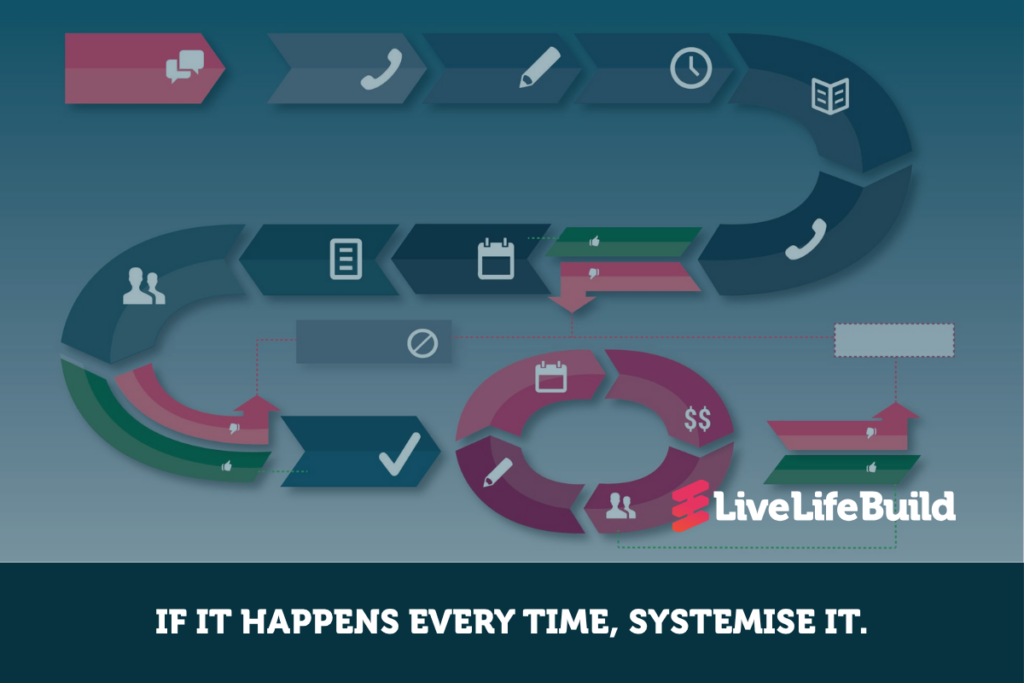
Once you have a clear enquiry pathway and a form collecting the right information, look for the parts of the process that can happen automatically.
For example:
- Send an immediate confirmation that the enquiry has been received
- Record the enquiry in your CRM or lead tracker
- Notify the right person on your team
- Send information about your process
- Set a follow-up task
- Move the enquiry through defined stages
Automation does not need to mean an expensive or complicated technology stack.
The principle is simple: if the same action happens every time, ask whether your system can handle it without you.
This is where systems can protect your time.
The Business Black Holes worksheet specifically identifies excessive time spent on manual admin, excessive time chasing leads that do not convert, phone calls that interrupt focused work, and failing to use systems to streamline tasks as potential leaks.
Every small interruption might seem harmless.
Collectively, they can become a significant drain on your working day.
4. Separate a genuine enquiry from free advice
One of the biggest traps for builders is giving away too much time too early.
A homeowner might want to know what they can build, what it might cost, what approvals they need, whether their ideas are realistic and what you would recommend.
Those are important questions.
But answering all of them during an initial enquiry or informal site visit can turn your expertise into unpaid consulting before you even know whether the project is suitable for your business.
Your job at the enquiry stage is not to solve the entire project.
It is to understand the potential client, understand the project, explain how you work and decide whether there is a suitable next step.
This is also where the right process can improve the client experience.
Instead of overwhelming a homeowner with a stream of ideas and possibilities, you can guide them through a structured pathway that helps them understand what happens next.
For builders using the PAC Process, the enquiry can become the starting point for a more deliberate client journey rather than an open-ended request for free information.
5. Follow up consistently and professionally
Getting an enquiry is only the beginning.
You need a follow-up process that tells you what happens next, when it happens and who owns it.
That might mean:
- Reviewing new enquiries at a dedicated time each day
- Responding within a timeframe you can consistently meet
- Recording every follow-up
- Sending useful information between conversations
- Setting reminders for the next contact
- Continuing to follow up when a potential client goes quiet
- Most importantly, tell potential clients what they can expect.
If your enquiry form says someone will hear from you within 48 hours, make sure you can deliver that.
And if the project is not a good fit, tell them.
Professionalism is not only about winning the right projects. It is also about communicating clearly when you cannot help.
Follow-up is not about chasing people endlessly.
It is about creating a reliable process so good opportunities do not disappear simply because the builder got busy.
Protect your time while improving the client experience
A good enquiry process does two jobs at once.
It gives potential clients a clearer, more professional experience.
And it protects the builder from unnecessary interruptions, unpaid work and endless follow-up.
That matters because the Successful Builder Solution does not define success by bigger revenue, bigger teams or bigger projects alone. It focuses on profitability, quality and wellbeing, with success defined on your own terms.
A better enquiry process can contribute to all three.
- Profitability: You spend more time on suitable opportunities and less on poor-fit leads.
- Quality: You create a consistent experience and set expectations earlier.
- Wellbeing: You reduce interruptions and stop every new enquiry from demanding your immediate attention.
That is what a good system should do.
It should make the business work better without making you work harder.
If client enquiries are still coming directly to your mobile, sitting unanswered in your inbox or taking up hours of your week, there is an opportunity to step back and redesign the process.
You do not need to make your business impersonal.
You need a system that allows you to be more intentional about where your time, expertise and energy go.
That is the kind of practical business improvement builders work through inside Elevate, using the Successful Builder Solution to look at profitability, quality and wellbeing together.
Learn more about Elevate and discover how you can build a business that works better for you.