How building business systems can create consistency, strengthen your team and give you more freedom from the day-to-day running of your building business
Your systems shouldn’t live in your head
Many builders believe they have systems in their business. But if your team still needs to ask you how things should be done, mistakes keep happening, or you can’t step away without your phone lighting up, you may not have a system that actually works.
Building business systems create reliability and consistency. They give your team clarity about how things are done, support quality and help clients feel confident that their project is being managed professionally.
Most importantly, a good system should reduce the number of things that only you know how to do.
Be sure to also subscribe to the Live Life Build YouTube channel.
A system is more than a document
When many builders hear the word “system”, they think of a procedure manual, checklist or set of instructions.
Those things can be useful, but a document sitting in a folder does not create freedom by itself.
A practical system answers four questions:
- Who is the right person?
- What is the right thing?
- What is the right way to do it?
- What is the right time to do it?

This is what makes a system useful in the real world.
It turns knowledge that currently lives in your head into something your team can understand, follow and improve.
Start with the problems that keep coming back
You do not need to systemise your entire business tomorrow.
Start by noticing what repeatedly creates frustration.
- Maybe your team keeps asking the same questions.
- Maybe you are repeating the same instructions.
- Maybe tasks are being completed differently by different people.
- Maybe clients keep asking what happens next.
- Maybe you are spending hours fixing issues that could have been prevented.
These recurring problems are telling you where a system is missing or where an existing process needs work.
The Business Black Holes framework highlights several of these exact leaks, including repeating instructions because of poor communication, spending hours fixing issues that could have been prevented with a system, spending too much time on manual admin and not using systems to make work more efficient.
Instead of asking, “What system should I create?”, start with:
“What keeps going wrong, taking too long or coming back to me?”
That question will usually lead you to the right place.
Get the knowledge out of your head
One of the biggest barriers to growth is having too much knowledge trapped with the builder.
You know how you want things done because you have years of experience.
Your team may have experience too. But if the process only exists as a conversation, a habit or something that you “just know”, it becomes difficult to delegate consistently.
This can leave you as the person everyone needs to speak to.
It can also make holidays, weekends and time away from the business harder than they should be.
It’s one of the biggest reasons builders feel trapped in their own businesses. So much of what they know lives in their heads instead of somewhere the team can follow it.
The first step is simple:
Write it down.
Not perfectly.
Not in a 50-page manual.
Just get the process out of your head and into a format someone else can understand.
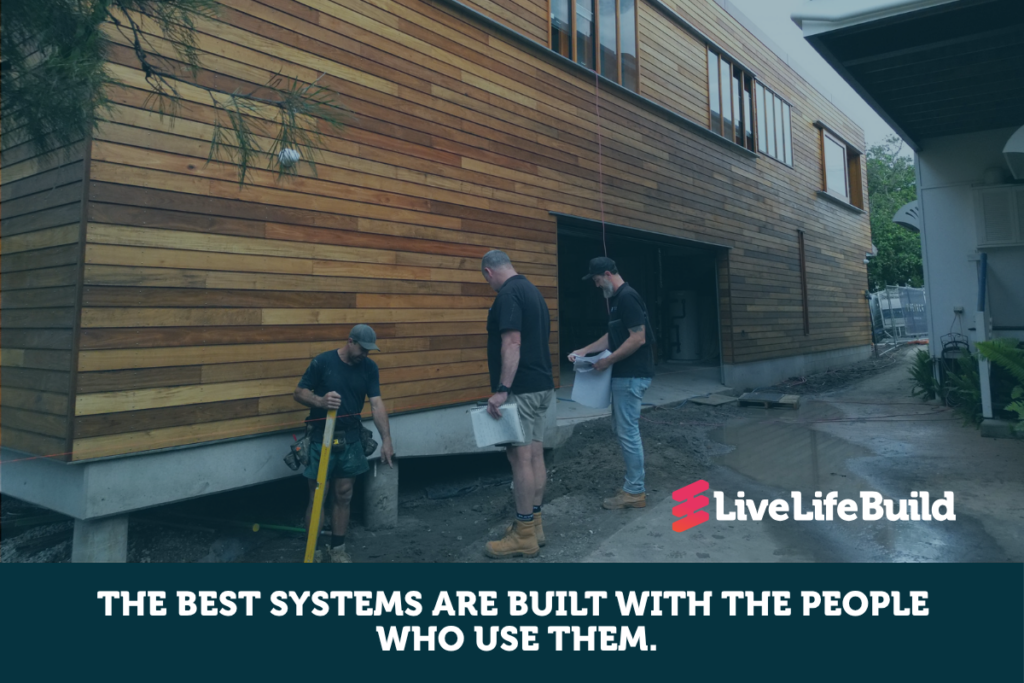
Build systems with the people who use them
Your systems should not be created in isolation.
Talk to the people who actually perform the work.
Ask your team:
- What makes this task difficult?
- Where do mistakes usually happen?
- What information is missing?
- What could make this easier?
- What should happen when something goes wrong?
- What would make the process clearer?
Your team can often see problems that you cannot because they are the people working inside the process every day.
This also helps create ownership.
A system is much more likely to be followed when the people using it understand why it exists and have had a chance to contribute to improving it.
Train your team to use the system
Creating the system is only part of the job.
Your team needs to know that the system exists, understand why it matters and know how to use it.
Freedom from your business comes in three steps: create the systems, train your team, then keep supporting and reviewing them.
Training also gives you an opportunity to find gaps.
If someone can’t follow the process, don’t automatically assume they’re the problem.
Ask whether the system is clear enough.
If the same question keeps coming up, the process may need to be improved.
That’s how systems become stronger over time.
Review your systems instead of filing them away
A system isn’t finished just because you have documented it.
Your business changes.
Your team changes.
Technology changes.
Clients change.
The way you deliver projects changes.
So your systems need to change too.
Set a regular time to review the processes that matter most.
Not reviewing or updating your processes is one of the business black holes builders most often overlook.
Ask yourself:
- Does this still work?
- Is the right person responsible?
- Is anything creating unnecessary steps?
- Are we getting the result we want?
- What could be improved?
The best systems are living parts of your business, not documents that disappear into a folder.
Use systems to strengthen quality, not just save time
It is easy to think of systems as an administration tool.
But their value goes much further.
A clear process can help your team understand expectations, maintain consistency and reduce preventable mistakes.
That is why Systems sits within the Quality Code of the Successful Builder Solution, alongside Team and Beyond the Code Building Methods.
Quality should not depend entirely on whether you happen to be available that day.
Your systems should help your business deliver the standard you expect, even when you are not standing over every task.
Systems are about freedom, not paperwork
You don’t need a system for the sake of having a system.
You need systems that solve real problems.
If a process saves your team time, reduces mistakes, clarifies responsibility, improves quality or stops the same question landing in your inbox every afternoon, it’s doing its job.
And when enough of those improvements come together, something bigger happens.
- You become less dependent on being involved in everything.
- You can delegate with greater confidence.
- Your team can make more decisions independently.
- Your clients get a more consistent experience.
- And you can start creating space for the parts of the business and life that matter to you.
That is the real purpose of systems.
Building business systems: create a business that works without you
If your business still depends on you remembering everything, answering every question and checking every detail, the answer isn’t necessarily to work harder.
It may be time to build the systems that allow the business to work differently.
Inside LaunchPad, builders learn practical, actionable ways to strengthen the foundations of a profitable residential building business and take greater control of their time.
Because the goal isn’t just to build a business that keeps you busy.
It’s to build a business that works for you, too.
Learn more about LaunchPad and discover how you can start building a more profitable business, with greater clarity and control.