The truth about custom home builders, the business behind the build and why success means more than delivering beautiful homes
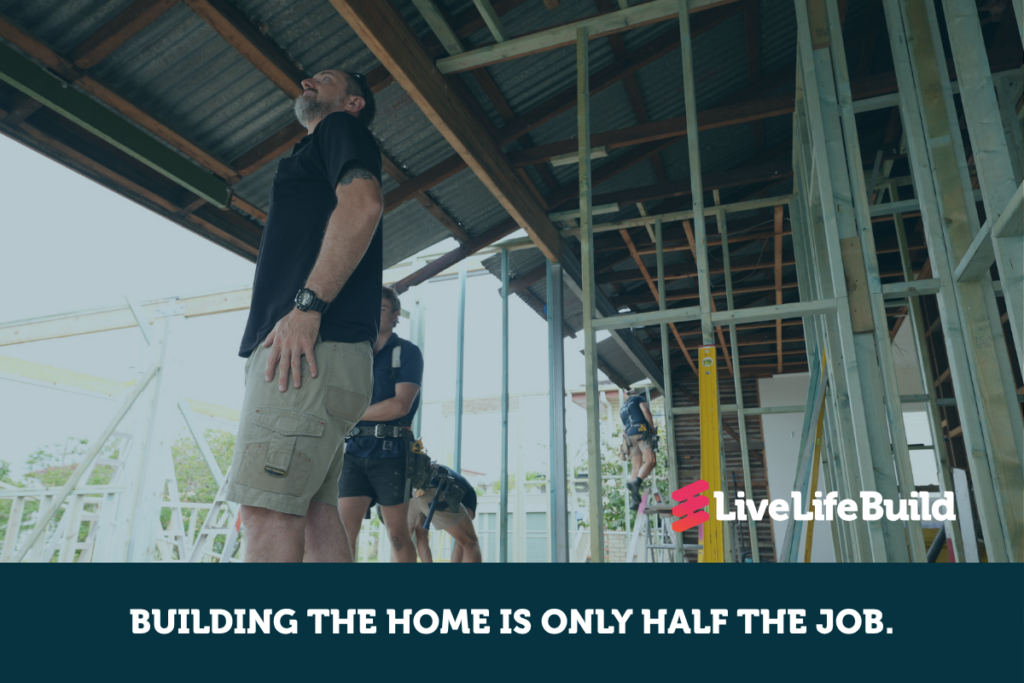
Building the home is only half the job.
Custom home builders know how to build. You know how to read plans, coordinate trades, solve problems and deliver a home that a client can be proud of.
But here is the truth about custom home builders that does not get talked about enough: being good at building does not automatically mean you have been taught how to build a good business. And it certainly does not mean you have to sacrifice your time, health or relationships to run one.
The industry can teach you how to build homes. The bigger challenge is learning how to build a business that works for you.
Be sure to also subscribe to the Live Life Build YouTube channel.
You were trained to build homes, not necessarily businesses
Most builders enter the industry because they love the work. They learn their trade, develop technical knowledge and gain experience on site. Eventually, they start their own business.
Then suddenly they are expected to understand sales, marketing, finance, contracts, team management, client relationships, systems, scheduling and leadership. Being excellent at construction does not automatically prepare you for all of that.
It is no surprise that builders can find themselves wearing every hat. You are the estimator, project manager, salesperson, problem solver, the person clients call, the person trades call, and the person your team asks when they are unsure. You may still be thinking about the business after everyone else has gone home.
That is not a personal failure. It is a business that may have grown faster than the structure around it.
Custom building creates complexity by nature
Custom homes are not production-line projects. Every client has different priorities, every site has its own conditions, every design has its own decisions, and every project can introduce something new.
That is part of what makes custom building rewarding. It is also why relying on memory, informal communication and ‘the way we have always done’ becomes risky as the business grows.
The more moving parts you have, the more important your systems, processes and standards become. You cannot remove every surprise from custom construction, but you can build a business that is better prepared to handle them.
Great craftsmanship does not protect a business from poor systems
A builder can produce beautiful homes and still have a business that is leaking time and money. Projects can run late, margins can disappear, communication can break down, and team members can keep coming back to the builder for decisions.
Clients can become frustrated because expectations were not clear. The builder can spend nights catching up on admin because there was never enough time during the day.
None of these problems necessarily mean you are a bad builder. They can mean the business needs stronger systems. In the Successful Builder Solution, Systems and Team are two of the three Quality standards, alongside building methods that go beyond code requirements.
Your business needs a structure that supports the standard you want to deliver.
Profitability is more than having work in the pipeline
Being busy can feel like success. But a full pipeline does not guarantee a profitable business.
If you do not know your numbers, underestimate jobs, spend too much time on work that does not generate a healthy return, or allow small profitability leaks to continue, more projects can simply create more pressure.
Profitability is one of the three Codes in the Successful Builder Solution. Its three Standards are Know Your Numbers, Schedule Your Time, and The Right Clients with the Right Process.
The question is not simply, ‘How much work do we have?’ It is, ‘Is the work we are taking on creating the business we actually want?’
Your clients are part of your business model
Not every client is the right client. That does not mean judging people by how much they spend. It means understanding whether the project, expectations, communication style, budget and process are compatible with the way your business works.
The right clients with the right process can create a much better experience for everyone involved. The wrong fit can create endless revisions, difficult conversations, unpaid time and pressure on your team.
A strong client process is not about becoming less personal. It is about creating clarity from the beginning, setting expectations, documenting decisions and communicating what happens next.
Your team should not need you for everything
One of the clearest signs that a building business has become too dependent on its owner is when every decision comes back to the builder.
‘What should I do here?’ ‘Can you check this?’ ‘Has the client approved that?’ ‘Which supplier should we use?’ ‘What happens next?’ If those questions are happening all day, you may have a delegation and systems problem.
The Business Black Holes worksheet highlights drains on time, energy and standards, including unclear roles, team members relying on the builder for every decision, repeated instructions, micromanagement and not training people to work independently.
Your goal is not to remove yourself from every part of the business. It is to make sure your involvement is intentional, with clear roles, consistent systems and a team equipped to take responsibility.
Wellbeing belongs in the definition of business success
If the business is profitable and your projects are high quality, but you are exhausted, disconnected from your family or unable to switch off, something is missing.
Wellbeing is not an optional extra in the Successful Builder Solution. It is one of the three Codes, alongside Profitability and Quality. Its three Standards are Health, Identity and Relationships with Others.
That is why success cannot simply be measured by turnover, project size, awards or team size. Success needs to work for you too.
You do not need to build someone else’s version of success.
There is no single definition of a successful building business. Maybe you want to build a larger company. Maybe you want a smaller, highly profitable business. Maybe you want a strong team so you can spend more time away from the site. Maybe you want to work on fewer, better projects or build a business your family can be proud of.
The point is to define success before the business defines it for you. The Successful Builder Solution brings three Codes together: Profitability, Quality and Wellbeing. Across those Codes are nine Standards that help builders assess what success means for them and where to focus next.
The Business Black Holes worksheet offers a practical starting point. It prompts you to look for the habits, decisions and gaps that drain time, energy or standards, then rate which ones are creating the biggest leak in your business.
The truth about custom home builders: build your version of success with LaunchPad
If you recognise yourself in this article, the answer is not to become a completely different builder. It is to build the business skills, systems and structure that allow your strengths to work better.
Live Life Build helps custom residential builders develop the skills and systems needed to build better businesses, deliver quality projects and create a better life beyond the build.
LaunchPad is the best place to start, with practical guidance to strengthen how you run the business behind the build, at your own pace.